
Let’s start with an uncomfortable truth.
In many organisations, the board does not fully trust the IT numbers placed in front of them.
Not because anyone is being misleading. Not because the IT team is underperforming. But because the numbers often lack context, comparability and clarity.
If you have ever been asked questions like “Why does our IT cost more than others?” “Are we properly resourced?” or “How do we know this investment is justified?”, you will know exactly what we mean.
When confidence in the numbers start to wobble, confidence in decisions wobble too. And that is where risk starts to creep in.
The Real Issue Is Not the Data
Most IT teams have plenty of data. In fact, many have too much.
They can report on tickets closed, system uptime, project milestones, headcount, supplier costs and infrastructure spend. Dashboards look impressive. Reports are detailed.
The challenge is not availability of data. It is alignment.
Board members are not asking whether the service desk answered 92 percent of calls within target. They are asking whether IT is appropriately funded, commercially efficient and strategically aligned.
If the numbers do not clearly answer those questions, trust erodes quietly in the background.
Five Reasons Boards Struggle to Trust IT Reporting
1. There Is No External Reference Point
Without benchmarking, costs and performance figures exist in isolation. A £5 million infrastructure spend might be excellent value. It might be excessive. Without peer comparison, it is impossible to know.
Boards are used to market comparators in finance, procurement and HR. When IT cannot provide similar context, it feels exposed.

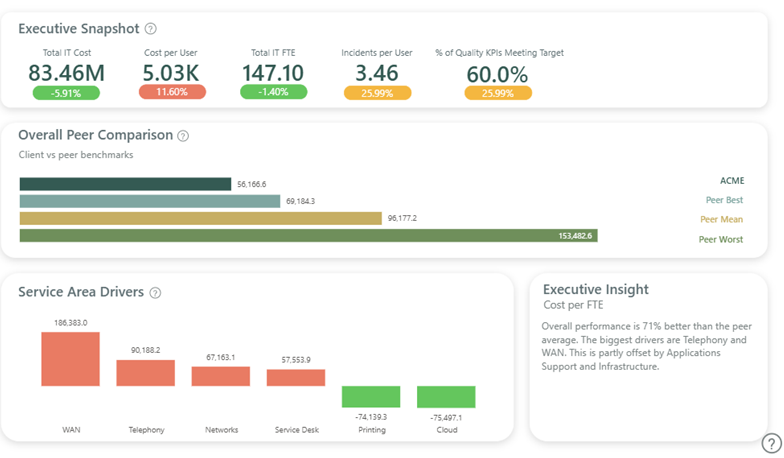
Example: Cost per user compared to peer best, mean and worst positions.
2. Metrics Are Operational Rather Than Strategic
Operational KPIs matter, but they rarely tell the whole story. Boards care about value, risk, resilience and return on investment.
If reporting focuses heavily on technical activity rather than business outcomes, the strategic narrative becomes blurred.
3. Costs Are Not Normalised
IT cost per user, per device or per location can vary widely depending on how they are calculated. If definitions are inconsistent or unclear, comparisons lose credibility.
Consistency and transparency are critical if the numbers are to withstand scrutiny.
4. Supplier Contracts Lack Commercial Context
Many organisations sign long-term contracts without fully understanding whether pricing remains competitive over time.
When renewal conversations begin, boards understandably ask whether better value could have been achieved.
5. Investment Cases Are Built on Assumptions
Transformation programmes often rely on projected efficiencies or risk reduction. If those assumptions are not supported by credible data, boards hesitate.
What Trust Looks Like
When boards trust IT numbers, conversations change.
Questions shift from challenge to collaboration. Discussions become forward looking rather than defensive. Decisions are made more quickly and with greater confidence.
Trust does not come from glossy slides. It comes from clarity, independence and comparability.
This is what board-ready IT reporting looks like in practice. A single view that combines cost, performance, peer comparison and executive insight.
How to Fix It
Introduce Independent Benchmarking
Benchmarking provides the missing context. It answers the question most boards are really asking: Are we broadly in line with comparable organisations?
It highlights where costs are high, where service levels are strong and where risks may be hiding.
Align Reporting to Business Outcomes
Translate technical metrics into commercial impact. Instead of reporting server uptime alone, link availability to operational continuity. Instead of listing project milestones, connect delivery to measurable business benefit.
Be Transparent About Methodology
Clearly explain how costs are categorised and how comparisons are made. Transparency builds credibility. And in a world where AI tools can generate polished dashboards and persuasive summaries in seconds, boards still need assurance that the underlying data has been validated, sense checked and independently grounded in reality.
Use Data to Support Investment Cases
When proposing investment, show how current performance compares to peers. Demonstrate where under investment may increase risk, or where over investment may signal inefficiency.
The Bigger Picture
Ultimately, this is not just about numbers. It is about confidence.
Boards need to feel assured that IT spend is proportionate, risks are understood and strategic decisions are evidence based.
When that assurance is in place, IT moves from being questioned to being trusted. From cost centre to strategic partner.
A Final Thought
If board conversations around IT feel tense, repetitive or overly detailed, it may not be a performance issue.
It may simply be a trust gap.
The good news is that trust can be rebuilt. With clear benchmarking, transparent reporting and commercially grounded analysis, IT leaders can walk into board discussions with confidence rather than caution.
And when the numbers stand up to scrutiny, so does the strategy behind them.